Researchers from the Vegetable Molecular Design and Breeding Innovation Team at the Institute of Vegetables and Flowers, Chinese Academy of Agricultural Sciences, have conducted pan-genome-based population analyses of Brassica crops, including Brassica rapa, Brassica napus, and Brassica juncea. Their work systematically reveals the evolutionary history of “A” genome Brassica species and the genomic characteristics of self-incompatibility (SI) loci. The findings were published in Nature Genetics.
Brassica species form the classical “U-triangle” model, consisting of three diploid species—Brassica rapa (AA), Brassica nigra (BB), and Brassica oleracea (CC)—and three allotetraploid species derived from hybridization among them: B. napus (AACC), B. juncea (AABB), and B. carinata (BBCC). The A-genome-carrying species—B. rapa, B. napus, and B. juncea—are important vegetables as well as major oil crops. Evidence suggests that B. rapa has been cultivated since the Neolithic period. A-genome tetraploid crops, B. napus and B. juncea, are believed to have originated approximately 7,500 years ago in the Mediterranean region and 8,000–14,000 years ago in West Asia, respectively. These crops have played an important role in the history of human agriculture. However, the early and widespread dissemination of A-genome crops, combined with the unclear identity of their wild ancestors, has left the origin and domestication history of B. rapa unresolved, limiting research on the evolution and formation of tetraploid species like B. napus and B. juncea.
In this study, the team constructed a variation map of 3,330 A-genome accessions and developed a Pan-Block pipeline for detecting pan-genome variation, assembling Pan-Blocks from 21 B. rapa genomes. Using the Pan-Block approach, the researchers identified an ancient genomic inversion event and, based on this, reconstructed the evolutionary history of the A genome. They proposed the origin of B. rapa and three major spread routes across Eurasia (Figure 1) and provided new evidence for the formation of B. napus and B. juncea species.
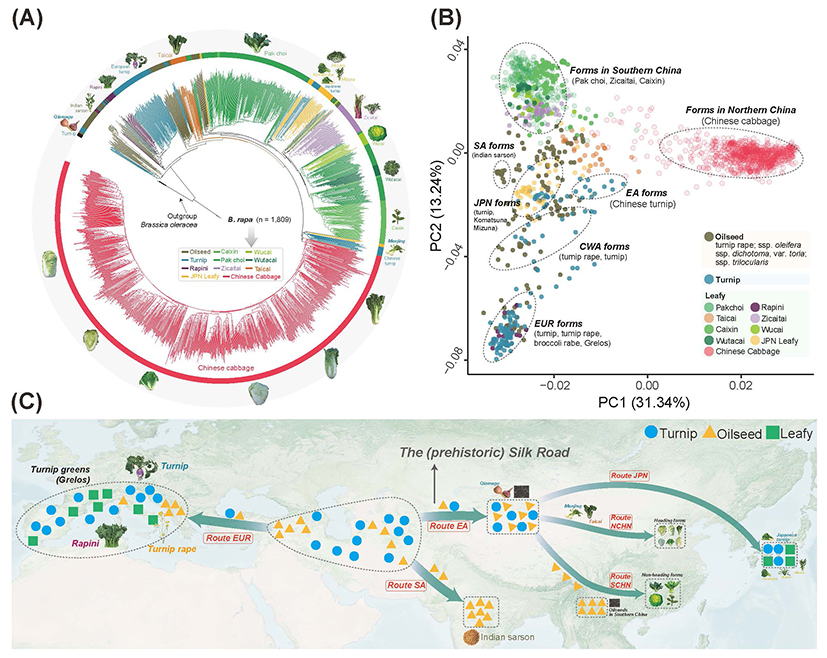
Figure 1. Origin and spread of B. rapa across Eurasia. a, Phylogenetic tree of the A genome constructed based on a variation map of 1,809 B. rapa accessions. b, Principal component analysis (PCA) of 1,809 B. rapa accessions, with EA, SA, EUR, and JPN representing East Asian, South Asian, European, and Japanese populations, respectively. c, Model of the spread routes of A-genome Brassica across Eurasia.
Self-incompatibility (SI) underpins the maintenance of genetic diversity in B. rapa and is widely used in hybrid breeding. Characterizing the sequence features of SI loci and identifying haplotypes are crucial for understanding SI mechanisms and their applications. However, the SI locus is highly complex, with extreme haplotype diversity, posing major challenges for SI research. By leveraging the Pan-Block strategy, this study uncovered complex patterns at the SI locus. The researchers found that different haplotypes possess unique transposon barcode patterns, forming a “genomic safe-box” structure that prevents recombination between haplotypes, which is essential for maintaining the SI system (Figure 2).
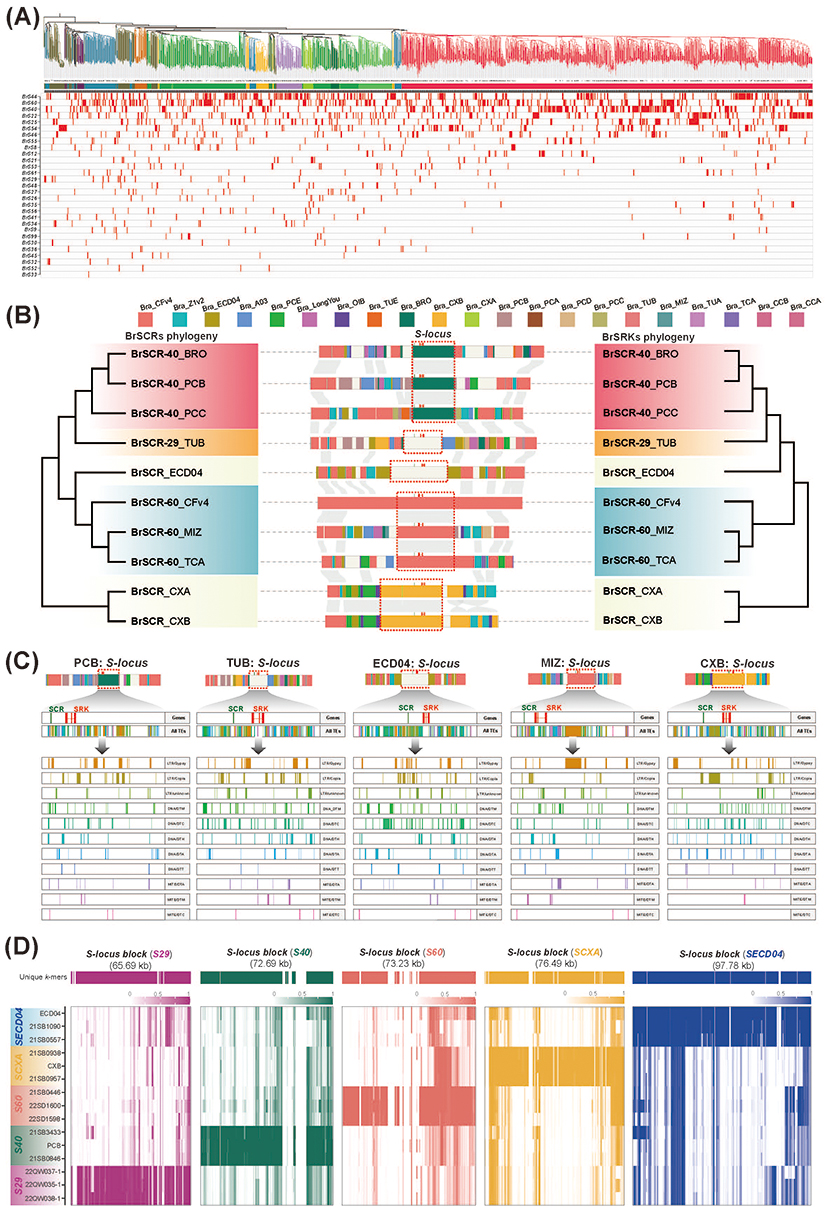
Figure 2. Characterization of self-incompatibility loci in B. rapa populations. a, Distribution of SI haplotypes in the B. rapa resequencing population. b, Pan-Block features of different SI haplotype regions. c, Pan-Block sequence composition associated with different SI haplotypes. d, Distribution of haplotype-specific k-mers across the sequences of five S-locus blocks.
The study was led by Researcher Xiaowu Wang and Researcher Jian Wu as corresponding authors, with Associate Researcher Xu Cai as the first author. Other contributors include PhD students Zhicheng Zhang, Lupeng Zhang, Fengming Li, Yufang Li, Haixu Chen, Lichun Chang, and Tingting Zhang, as well as Researcher Jianli Liang. The research was supported by the National Key R&D Program of China (2021YFF1000100), the Youth Project of the National Natural Science Foundation, and the CAAS Innovation Project.
https://www.nature.com/articles/s41588-026-02626-7

 Chinese