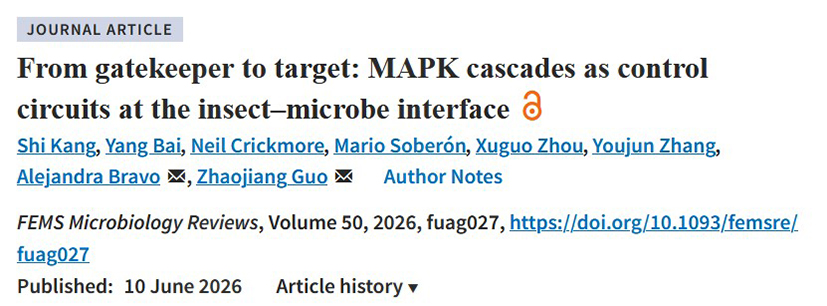
Recently, the research team led by Professor Zhaojiang Guo and CAE (Chinese Academy of Engineering) Academician Youjun Zhang from our institute published a review article in the international microbiology journal FEMS Microbiology Reviews (IF = 16.9), entitled "From gatekeeper to target: MAPK cascades as control circuits at the insect-microbe interface". This review systematically summarizes the dual roles of insect MAPK signaling at the host-microbe interface, functioning both as a “gatekeeper” of host defense and as a “target” for pathogen attack and manipulation, and proposes a theoretical framework of MAPK cascades as a control system for the insect-microbe attack and defense loop.
Insects are not only the most diverse animal group on the earth, but also serve as vectors for numerous plant viruses, human arboviruses, and protozoan parasites. At the same time, they themselves are constantly threatened by bacteria, fungi, and viruses. Over long term coevolution, insects have evolved a sophisticated immune regulatory network.
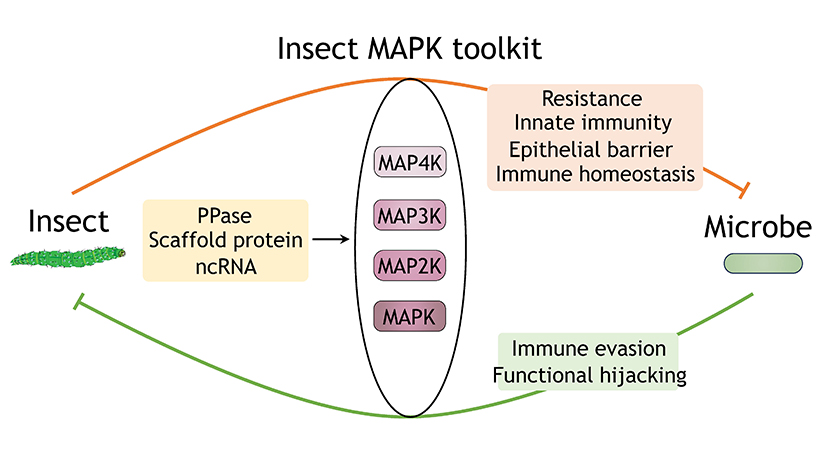
In insects, the MAPK cascade comprises three main branches: extracellular signal-regulated kinase (ERK), c-Jun N-terminal kinase (JNK), and p38 kinase. These branches integrate pathogen-associated molecular patterns, tissue damage signals, and metabolic cues, ultimately inducing immune effector responses such as antimicrobial peptide production and reactive oxygen species generation. The review highlights that MAPK pathways not only regulate intestinal epithelial barrier defense, coordinate cellular and humoral immunity, and participate in xenobiotic detoxification adaptation, but also cooperate with other signaling pathways to maintain immune homeostasis and prevent excessive immune responses that could cause physiological damage. In the war between pathogenic microorganisms and insects, many pathogens have evolved sophisticated immune evasion and functional hijacking strategies. These pathogens suppress the immune functions of MAPK or activate its growth and development regulatory functions, thereby weakening host immunity and even exploiting the pathway to promote their own invasion, replication, and transmission.
The intensity and duration of MAPK signaling are tightly regulated at multiple levels by protein phosphatases, scaffold proteins, and non-coding RNAs, which together determine the precision and plasticity of signal output. Therefore, MAPK-related nodes hold promise as new targets for pest control and interruption of vector-borne pathogen transmission. Future strategies for managing agricultural pests and insect vectors could involve pharmacological or genetic interference with specific MAPK nodes to enhance pest susceptibility to microbial biopesticides (such as Bt, entomopathogenic fungi, and insect viruses) or to reverse metabolic resistance. For vector-borne diseases, disrupting MAPK modules exploited by pathogens could reduce vector competence. Although challenges such as off-target effects and pathway pleiotropy remain, branch-specific, tissue-specific, and developmental stage-specific intervention strategies may enable precise control.
Dr. Shi Kang (Associate Professor) from the Key Invasive Alien Species Team, College of Life Sciences, Hebei University, and Dr. Yang Bai (Postdoctoral Fellow) from our institute are the co-first authors of this paper. Professor Zhaojiang Guo and Professor Alejandra Bravo from the National Autonomous University of Mexico are the corresponding authors. CAE Academician Youjun Zhang provided important guidance for this study. This work was supported by the Innovative Research Group and General Program of the National Natural Science Foundation of China, as well as the Science and Technology Innovation Project of the Chinese Academy of Agricultural Sciences.
Original link: https://doi.org/10.1093/femsre/fuag027

 Chinese