Recently, the flower seedlings propagation research group from the Institute of Vegetables and Flowers, Chinese Academy of Agricultural Sciences, published an online paper titled “The haplotype-resolved T2T genome assembly reveals the evolution and adaptation mechanisms of cold resistance in Rosa beggeriana” in the international horticultural journal 《Horticulture Research》(IF = 9.5, Q1).
Rosa beggeriana, a wild rose native to Northwest China, is known for its exceptional cold tolerance and serves as a key cold-tolerance breeding parent for modern roses. Since the 1990s, it has been used to develop the cold-hardy ‘Tianshan’ series of modern roses. However, the lack of genomic information for this species has hindered the discovery of its valuable cold-resistance genes and the study of their regulatory mechanisms.
In this study, the researchers integrated PacBio HiFi, Illumina, and Hi-C sequencing data to generate the first complete, gapless, haplotype-resolved telomere-to-telomere (T2T) genomes of R. beggeriana. Genome assembly combined with haplotype phasing and chromosome anchoring produced two distinct haplotypes: Hap1 (417.13 Mb) and Hap2 (421.87 Mb). Both haplotypes harbored 7 centromeres and 14 telomeres. A total of 38,039 and 37,962 protein-coding genes were predicted in Hap1 and Hap2, respectively.
Based on these high-quality genomes, this study revealed that R. beggeriana undergone the whole-genome triplication (γ) and duplication (WGD) events, with an ancient WGD event shared with R. chinensis prior to species divergence at approximately 8.91 million years ago. This study also identified 1,917 species-specific genes and 206 expanded gene families, which are significantly enriched in stress response pathways.
Further analysis of the cold-response transcriptome and co-expression networks constructed a core regulatory network involving calcium signaling, reactive oxygen species (ROS) homeostasis, and hormone crosstalk. This study functionally characterized the cold-responsive gene RbDHN3-1. Overexpression of this gene in rose suspension cells and tobacco led to a lower freezing point and increased antioxidant enzyme activity, thereby significantly enhancing cold tolerance.
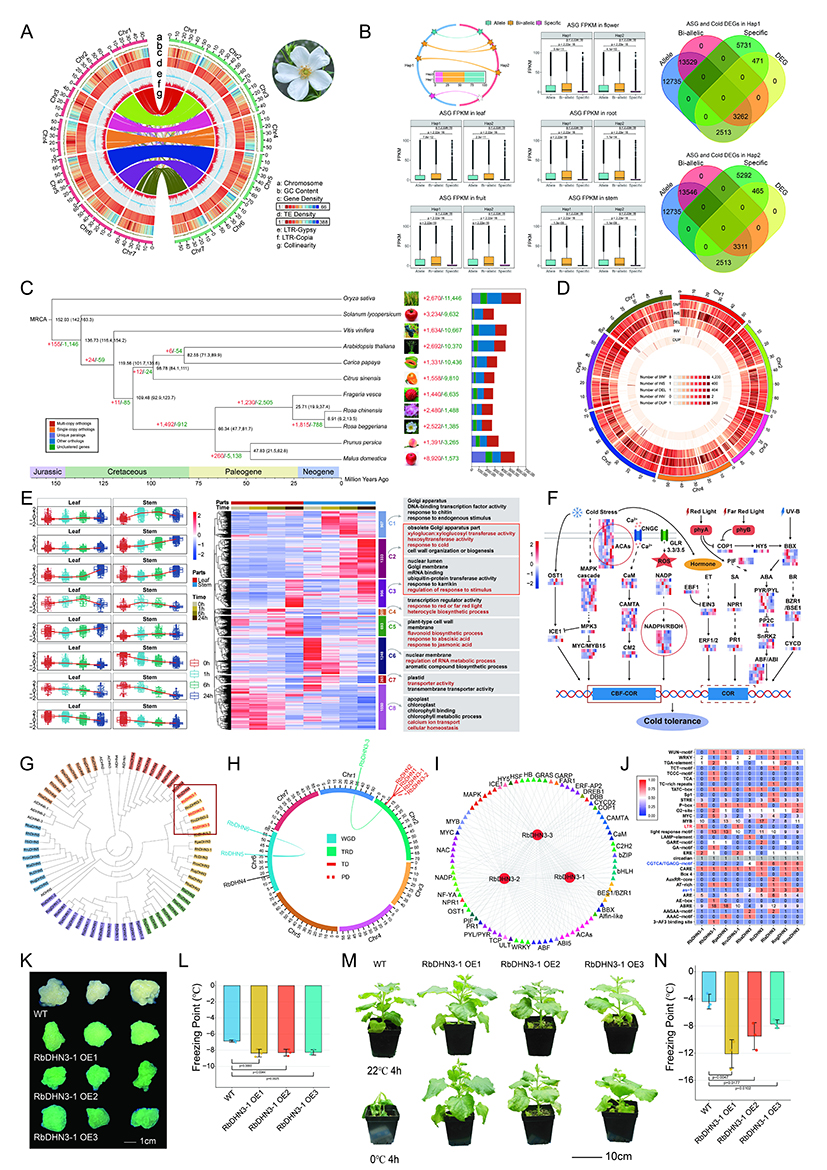
This study reports the first T2T single-haplotype genome assembly of a cold-resistant rose, providing a crucial theoretical foundation and genetic resource for accelerating the molecular breeding of cold-tolerant roses.
Postdoctoral researcher Li Huayang, doctoral student Wang Xiang, and assistant researcher Kou Yaping contributed equally to this work as co-first authors. Prof. Yang Shuhua, Prof. Cheng Feng, and Prof. Ge Hong are the corresponding authors. This work was supported by the National Key Research and Development Program (2022YFD1200504 and 2024YFD1200503) and the National Natural Science Foundation of China (No.32471959).
https://doi.org/10.1093/hr/uhag210

 Chinese