Recently, the Broccoli and Cabbage Group at the Institute of Vegetables and Flowers (IVF), Chinese Academy of Agricultural Sciences (CAAS), published a research paper titled "A RUBY Reporter Enables Visual Identification of Transformed Calli for Efficient Genome Editing in Broccoli" in the internationally renowned botany journal Plant, Cell & Environment (CiteScore 12.3, Q1). Addressing the long-standing bottleneck of low genetic transformation efficiency and underdeveloped regeneration systems that have constrained the development of functional genomics and molecular breeding in broccoli, this study innovatively established an efficient and visual genetic transformation and genome editing technology system.
The core innovation of this research lies in breaking through the inefficient model traditionally dependent on rooting induction for regenerating plants. The team utilized Agrobacterium rhizogenes carrying the RUBY reporter gene for transformation, cleverly bypassing the "hairy root induction" stage and establishing a direct "callus-regenerated shoot" transformation workflow. The successful application of the RUBY reporter gene enabled visual identification of transformation events with the naked eye, as positive calli exhibited a distinct red color, allowing intuitive identification without relying on resistance screening. This greatly simplified the screening process and reduced workload. Experiments demonstrated that this system shortened the transformation cycle to 8–10 weeks, achieved a transformation efficiency of 16.4% and a regeneration efficiency of 24.2%, and successfully validated precise editing of target genes.
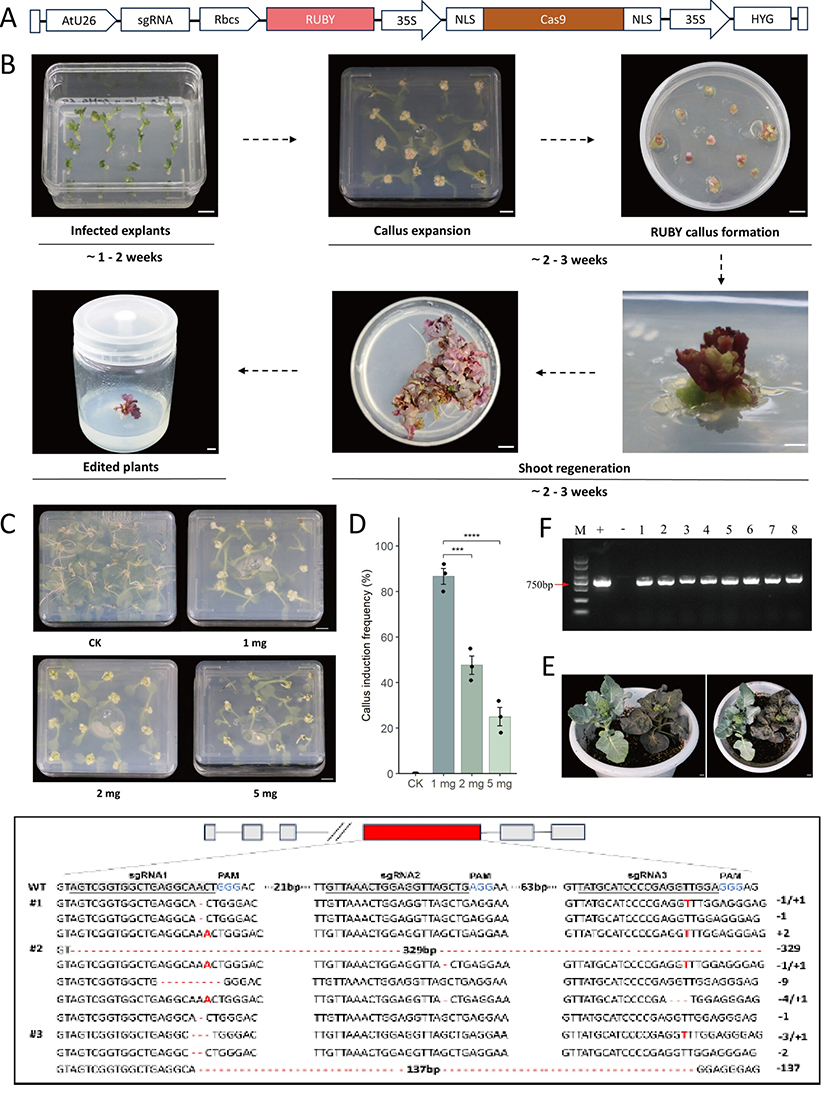
Visual Regeneration System for Broccoli Gene Editing (CRISPR/Cas9-BoARF7) Plants
This biotechnological breeding achievement effectively addresses the technical challenge of regenerating transgenic plants in Brassica oleracea crops such as broccoli. It not only provides a rapid and efficient gene editing tool for functional gene research but also offers a new technical reference for genetic improvement of other cruciferous crops. This holds significant scientific value and application significance for accelerating vegetable germplasm innovation and molecular breeding processes.
The Institute of Vegetables and Flowers, CAAS, is the first affiliation of this paper. Lai Shangxiang, a joint master's student between IVF, CAAS, and the College of Horticulture Science, Zhejiang A&F University, is the first author. Researcher Li Zhansheng is the corresponding author. Dr. Huang Yunshuai, a young faculty member from the College of Horticulture Science, Zhejiang A&F University, also provided support. This research was funded by the Beijing Natural Science Foundation (6262025), the Major Project of the National Agricultural Industry Technology System (CARS-23-A05), and the Agricultural Science and Technology Innovation Program (ASTIP).
Original link: https://onlinelibrary.wiley.com/doi/epdf/10.1111/pce.70493

 Chinese