Recently, the molecular design breeding team at the Institute of Vegetables and Flowers, Chinese Academy of Agricultural Sciences, established an efficient genetic transformation system for pepper. This system overcomes major technical bottlenecks, including low regeneration efficiency, low transformation efficiency, and difficulties in screening. Targeted gene editing was further achieved using CRISPR/Cas9. The relevant findings, entitled “An Efficient Spectinomycin and Visual Marker-based Genetic Transformation System and Gene Editing in Pepper,” have been published in Horticulture Research.
Pepper (Capsicum annuum) is an economically important vegetable and spice crop worldwide. Compared with model crops such as rice and tomato, pepper remains highly recalcitrant to genetic transformation. Persistent obstacles, namely low transformation efficiency, poor shoot elongation, and high false-positive rates during screening, restrict gene function studies and molecular breeding programmes. Establishing a robust, efficient, and easily screenable transformation platform represents a critical technical priority for pepper breeding research.
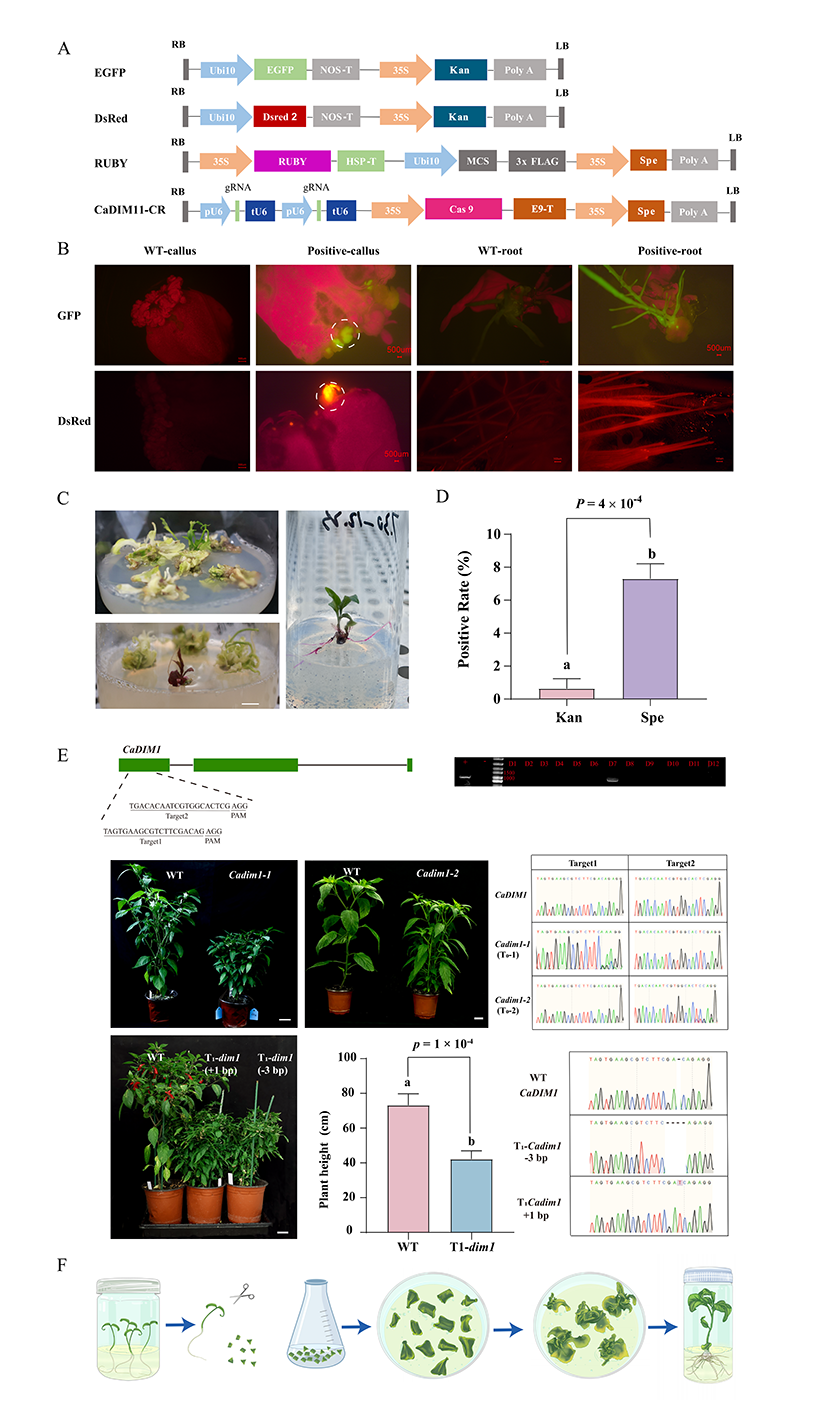
The research team systematically optimised the full Agrobacterium-mediated transformation pipeline for pepper. Cotyledons and cotyledon petioles were selected as optimal explants, and hormone combinations at different developmental stages were optimised, resulting in a shoot induction rate of approximately 80% and a shoot elongation rate of approximately 50%. Spectinomycin was adopted to replace kanamycin for selection. Coupled with the RUBY visual reporter for early identification, the transgenic positive rate increased from approximately 1% to more than 8%. This strategy effectively reduces false positives and minimises the workload associated with molecular validation.
Leveraging the optimised transformation workflow, researchers performed CRISPR/Cas9-mediated targeted gene editing of the pepper CaDIM1 gene. Stable, heritable mutants with distinct phenotypic alterations were recovered, demonstrating the practical potential of the optimised transformation system. The established platform enables efficient and visualisable genetic transformation and gene editing in pepper. It facilitates gene function studies and the targeted improvement of valuable agronomic traits through molecular design breeding, and provides a useful reference for research on other recalcitrant plant species.
Dr. Xingxing Wang from the Institute of Vegetables and Flowers, CAAS, is the first author. Professor Feng Cheng is the corresponding author, and Associate Professor Shumin Chen is a co-corresponding author. Professor Kang Zhang and Associate Professor Lei Zhang also contributed to this work. Financial support was provided by the State Key Laboratory of Vegetable Biobreeding, the National Natural Science Foundation of China, and the Key Laboratory of Horticultural Crop Biology and Germplasm Innovation, Ministry of Agriculture and Rural Affairs.
Article link: https://doi.org/10.1093/hr/uhag283

 Chinese