Recently, a research team led by Academician Youjun Zhang at our institute, in collaboration with several research institutions in China and abroad, published a research article entitled “Resistance fuels biological invasions while offering new avenues for RNAi-based pest management” in the internationally renowned journal Trends in Biotechnology (IF=16.6). Drawing on 20 years of nationwide monitoring data on whitefly population dynamics, the study identifies insecticide resistance as a key driver of population replacement in whiteflies. It systematically elucidates the molecular mechanism by which the cytochrome P450 gene CYP6CX3 mediates imidacloprid resistance and explores an RNA interference (RNAi) management strategy targeting this gene, offering new avenues for whitefly resistance management and environmentally friendly pest control.
The whitefly (Bemisia tabaci) is a major invasive agricultural pest worldwide, often described as a “superpest,” and poses a serious threat to crop production. Among the members of this species complex, the B (MEAM1) and Q (MED) cryptic species are two of the most invasive and damaging worldwide. However, how insecticide resistance affects competitive displacement and how resistance mechanisms can be harnessed to develop environmentally friendly pest-control technologies, remain unresolved scientific questions.
By analyzing nationwide long-term monitoring data on whitefly populations from 2003 to 2023, the researchers characterized the succession dynamics of invasive whitefly populations. They found that the dominant whitefly populations in Chinese fields had shifted from B (MEAM1) to Q (MED). Further bioassays and analyses of detoxification enzyme activity in B and Q whiteflies showed that Q whiteflies had greater resistance to imidacloprid and that cytochrome P450 detoxification enzyme activity was significantly correlated with imidacloprid resistance levels. These findings indicate a close association between differences in insecticide resistance and the replacement of B by Q whitefly populations. Based on these observations, systematic screening and functional analysis of P450 family genes identified CYP6CX3 as a key gene underlying imidacloprid resistance. The researchers confirmed that CYP6CX3 overexpression and the F222L and F226I amino acid substitutions act synergistically to enhance imidacloprid resistance in Q whiteflies. To elucidate the regulatory mechanism of CYP6CX3 overexpression, the team conducted promoter activity assays, protein interaction analyses, phosphorylation assays, and other experiments. These revealed how the MAPK-USP signaling pathway regulates CYP6CX3 overexpression. Together, the results systematically explain the development of metabolic resistance to imidacloprid in Q whiteflies at three levels—signal transduction, transcriptional regulation, and detoxification metabolism—and provide a basis for identifying targets for resistance intervention. The researchers then established a spray-induced gene silencing (SIGS) system targeting CYP6CX3. Laboratory and greenhouse experiments showed that spraying dsCYP6CX3 reduced CYP6CX3 gene expression, significantly increased whitefly susceptibility to imidacloprid, and substantially alleviated sooty mold damage. This approach shows promising potential for whitefly resistance management and environmentally friendly pest control. In addition, the team conducted a preliminary ecological safety assessment of dsCYP6CX3 through bioinformatic analyses and laboratory tests on non-target organisms, providing experimental evidence for subsequent environmental risk assessment and technological optimization.
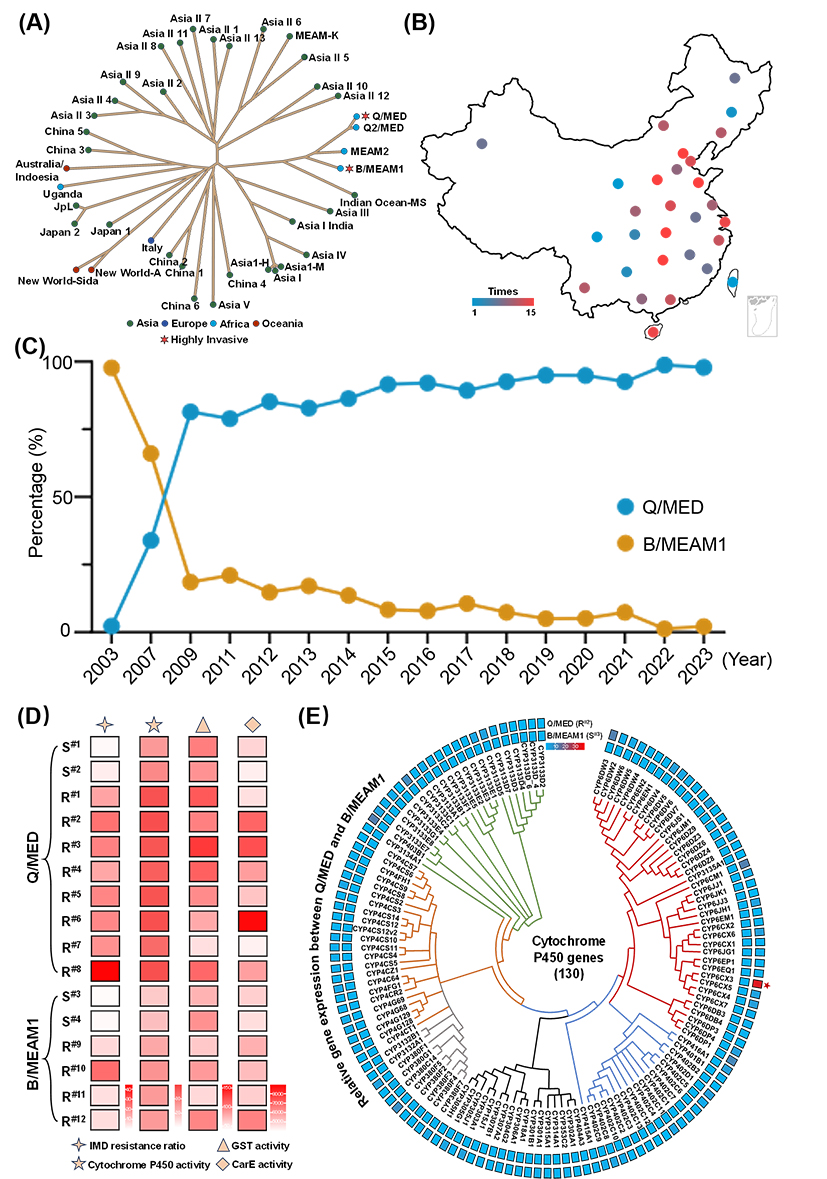
Figure 1. The 20-year invasion dynamics and comparative metabolic resistance mechanisms of B. tabaci B/MEAM1 and Q/MED in China (2003–2023).
By integrating long-term field monitoring of whitefly populations, molecular investigations of insecticide resistance mechanisms, and RNAi-based pest-control technology, this study reveals the molecular mechanisms through which insecticide resistance drives whitefly population replacement. It also translates knowledge of pest resistance mechanisms into new targets for RNAi-based control. The findings provide an important theoretical foundation and technical support for slowing the development of pest resistance, improving the effectiveness of conventional insecticides, and developing novel RNAi-based biopesticides. They also open up new avenues for the environmentally friendly and sustainable management of invasive agricultural pests.
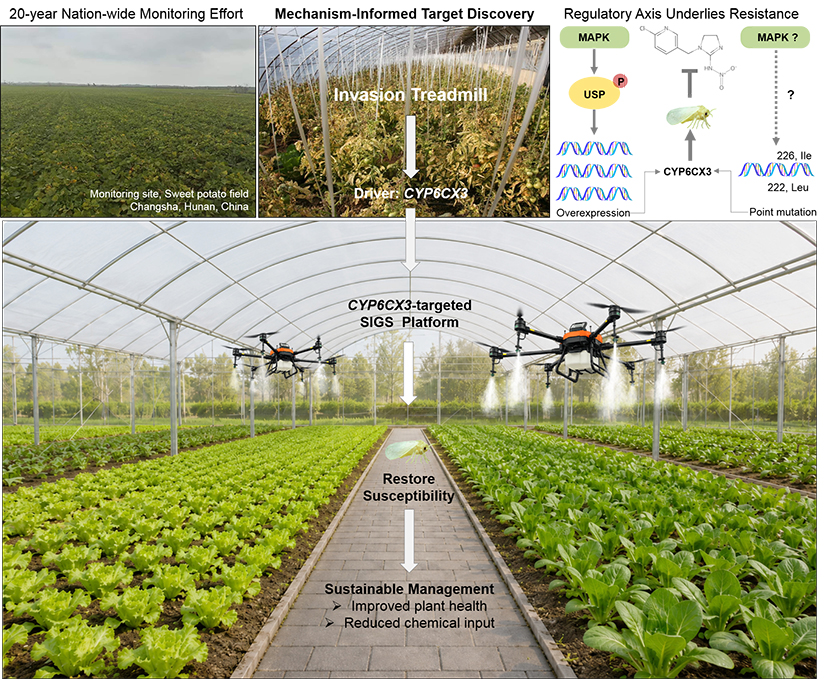
Figure 2. SIGS-based whitefly management strategy informed by the CYP6CX3 resistance mechanism.
Postdoctoral researchers Chao He and Jinjin Liang and doctoral student Rong Zhang from the Institute of Vegetables and Flowers, Chinese Academy of Agricultural Sciences; Dr. Pei Cao from the Research Institute of Forestry, Chinese Academy of Forestry; and Dr. Huixin Zheng from Hunan University of Humanities, Science and Technology are co-first authors of the paper. Professor Chris Bass of the University of Exeter; Research Professor Xin Yang of the Institute of Vegetables and Flowers, Chinese Academy of Agricultural Sciences; Professor Xuguo Zhou of the University of Illinois Urbana-Champaign; and Academician Youjun Zhang of the Institute of Vegetables and Flowers, Chinese Academy of Agricultural Sciences are co-corresponding authors. The study was supported by the National Key Research and Development Program of China, the National Natural Science Foundation of China, the China Agriculture Research System, and the Agricultural Science and Technology Innovation Program of the Chinese Academy of Agricultural Sciences, among other programs.
Original article: https://www.cell.com/trends/biotechnology/fulltext/S0167-7799(26)00434-8

 Chinese