Recently, the Disease Research Group of the Plant Protection Laboratory at the Institute of Vegetables and Flowers, Chinese Academy of Agricultural Sciences, published a research paper titled" The glycosylated root-knot nematode effector Minc10750 suppresses plant immunity by destabilizing host chitinases" in the internationally renowned academic journal New Phytologist (IF 8.7). This study, for the first time, elucidates the finely-tuned regulatory mechanism by which a glycosylated nematode effector protein degrades host chitinases to undermine plant basal immunity, providing a novel target for breeding root-knot nematode-resistant crops.
Root-knot nematodes (RKNs) are among the most devastating plant-parasitic nematodes, capable of infecting over 3,000 plant species and causing billions of dollars in global agricultural losses annually. These nematodes secrete effector proteins into plant cells to suppress host immunity and reprogram plant development. However, the molecular mechanisms by which effectors precisely target and dismantle plant defense enzymes have remained largely elusive. The team discovered that the M. incognita effector Minc10750 is highly expressed in the subventral esophageal glands during early infection. It directly binds to the GH19 catalytic domain of plant chitinases and promotes their degradation via the 26S proteasome pathway.Further, N-glycosylation of Minc10750 is a prerequisite for its interaction with chitinases and for its virulence—mutation of the glycosylation sites abolishes the effector's target-binding ability and prevents its normal accumulation in the nucleus. Degradation of chitinases significantly suppresses downstream immune signaling, including MAPK activation and reactive oxygen species (ROS) bursts. Functional validation demonstrated that overexpression of chitinase enhances plant resistance to nematodes, whereas knockout of the gene leads to markedly increased susceptibility. Transcriptome analysis further revealed that chitinase-mediated expression of defense-related transcription factors is broadly suppressed in Minc10750 transgenic plants.
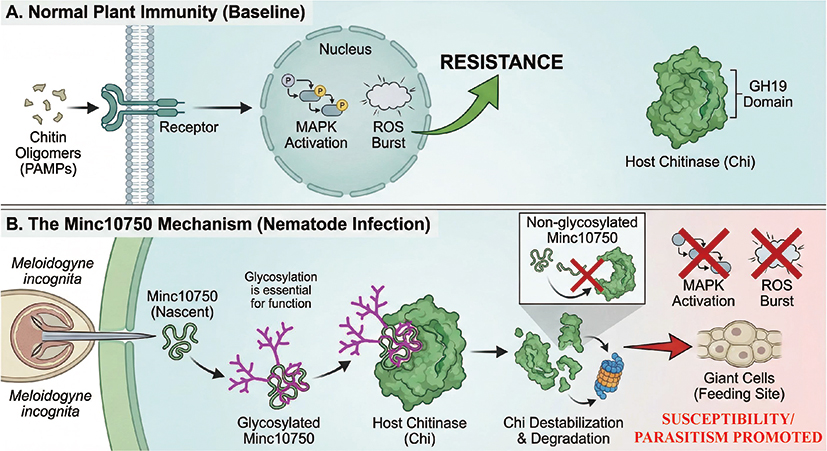
Figure 1.The root-knot nematode effector Minc10750 suppresses plant chitinase-triggered immunity during parasitism.
This study is the first to reveal that N-glycosylation is a prerequisite for an effector protein to target and degrade host chitinases, providing a clear molecular target for improving crop resistance to nematodes through chitinase gene modification.
The Institute of Vegetables and Flowers, Chinese Academy of Agricultural Sciences is the first affiliation of this paper. Postdoctoral researcher Rui Liu is the first author, and Professors Jianlong Zhao and Zhenchuan Mao are the co-corresponding authors. Professor Bingyan Xie, as well as Professors Pierre Abad, Bruno Favery, and Micha l Quentin from the French National Research Institute for Agriculture, Food and Environment (INRAE), provided valuable guidance on the study design. This research was supported by the National Key R&D Program of China, the National Natural Science Foundation of China, the China Agriculture Research System (CARS-23), and the Innovation Program. Special thanks to Professor Xingwang Liu from China Agricultural University for his guidance and assistance.
Original link: http://doi.org/10.1111/nph.71419

 Chinese