Recently, Researcher Zhang Yangyong's team from the Cabbage and Broccoli Research Group at the Institute of Vegetables and Flowers, Chinese Academy of Agricultural Sciences, published a significant brief communication titled" A 15.8-Mb Alien Radish Chromosomal Fragment Inversion Drives Fertility Restoration and Telomere Loss of C09 in Brassica oleracea" online in Plant Biotechnology Journal. This study elucidates the molecular mechanism by which the cabbage Ogura cytoplasmic male sterility (Ogura CMS) fertility restorer line (FRL) both restores fertility in Ogura CMS varieties and rapidly eliminates alien genomic fragments in the progeny, allowing the genetic background to quickly return to that of cabbage. This provides crucial theoretical support and a technical pathway for the efficient innovation and reuse of excellent Ogura CMS germplasm resources.
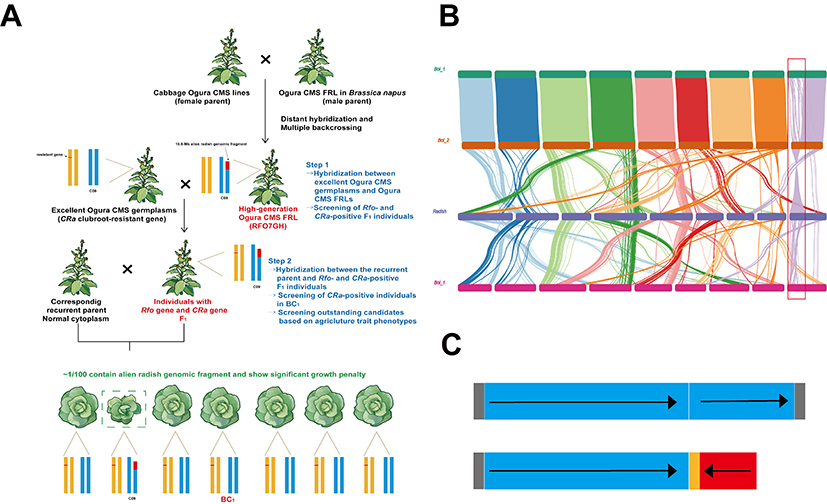
The widespread application of Ogura CMS in cabbage offers a simple and efficient approach for hybrid seed production, with Ogura CMS being the most commonly used type. However, since the progeny of male-sterile lines cannot be used for further breeding innovation, the lack of Ogura CMS FRLs has become a major bottleneck limiting cabbage variety improvement. Consequently, there is an urgent need to develop Ogura CMS FRLs. Through over a decade of distant hybridization and multiple generations of backcrossing, the research team successfully developed high-generation Ogura CMS FRLs in cabbage. By combining Oxford Nanopore ultra-long reads, Illumina short reads for error correction, and Hi-C scaffolding for chromosomal phasing, they achieved a chromosome-level genome assembly of the BC7 generation Ogura CMS FRL RFO7GH.
The study revealed that in the FRL, a 15.8-Mb alien radish genomic fragment (R09: 0–15,789,821 bp) containing the Rfo gene was inverted and integrated into the long-arm terminal region of C09 in RFO7GH, replacing the homologous 28.2-Mb cabbage genomic fragment (C09: 0–28,239,208 bp). After the fertility restoration gene Rfo fulfills its function, the entire alien radish fragment exhibits an extremely low transmission rate (~1%) in the progeny and did not recombine with other chromosomal regions, resulting in the vast majority of progeny (~99%) carrying no alien radish genomic fragment. Moreover, plants carrying the alien radish fragment exhibited significantly inferior agronomic performance compared to plants without alien radish fragments, including outer leaf length, leaf width, and economic yield, making them easily eliminated during breeding based on phenotypic selection. These characteristics facilitate the rapid and thorough elimination of the alien fragment after fertility restoration is achieved, accomplishing the dual objectives of restoring Ogura CMS fertility and rapidly purging the alien fragment in subsequent generations. The efficacy of this Ogura CMS FRL system was validated by restoring fertility in seven genetically diverse cultivars carrying resistance genes to clubroot (CRa), black rot (Xcc3), and Fusarium wilt (Foc1) diseases.
This work was supported by grants from the National Natural Science Foundation of China (32172578), the earmarked fund for the Modern Agro-Industry Technology Research System, China (CARS-23) and the Science and Technology Innovation Program of the Chinese Academy of Agricultural Sciences (CAAS-ASTIP-IVFCAAS). Researcher Zhang Yangyong and Associate Researcher Wang Yong from the Institute of Vegetables and Flowers, CAAS, are the co-corresponding authors of the paper. Ren Wenjing (Ph.D. student), Si Jinchao (Ph.D. student) and Feng Yiliao (master’s student), as well as Yu Hailong (Associate Researcher) are the co-first authors of the paper.
Link to this paper:https://onlinelibrary.wiley.com/doi/full/10.1111/pbi.70396 campaign=wolearlyview

 Chinese