Recently, the Flower Cultivation Team from the Institute of Vegetables and Flowers, Chinese Academy of Agricultural Sciences (CAAS), made significant progress in elucidating plant aluminum detoxification and hyperaccumulation mechanisms. The related research, entitled "Tandemly Duplicated HmALS3 Gene Cluster Mediates Aluminum Hyperaccumulation via a Heteromeric Transport Complex in Hydrangea macrophylla," has been published in the international journal Journal of Hazardous Materials (IF = 11.3).
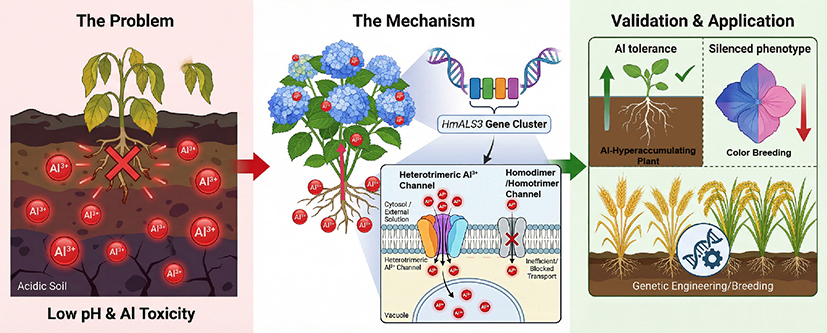
Aluminum (Al) toxicity is one of the primary constraints on global agricultural production in acidic soils. Acidic soils such as the red soils widespread in southern China release highly bioactive toxic Al3+ ions from otherwise harmless aluminum compounds, severely inhibiting root growth, reducing crop yields, and threatening food security and ecological health. Hydrangea macrophyllais a typical aluminum-hyperaccumulating plant that can accumulate over 1,000 mg/kg dry weight of aluminum in its leaves without exhibiting toxicity symptoms. The blue coloration of hydrangea sepals is a direct visual indicator of internal aluminum concentration; however, the molecular mechanism underlying its high-capacity intracellular sequestration of aluminum had long remained unclear.
To address this question, the research team identified an aluminum-inducible tandem duplicated gene cluster, HmALS3.1–HmALS3.4, which serves as the major regulatory module for aluminum hyperaccumulation in hydrangea. The study found that the proteins encoded by this gene cluster are localized to the vacuolar membrane as transmembrane transporters. Among them, HmALS3.1 is highly conserved with homologs in other species, whereas HmALS3.2–HmALS3.4 show significant sequence divergence, suggesting functional specialization. Using AlphaFold 3, the team performed high-confidence 3D structural predictions of HmALS3 dimeric and trimeric complexes, revealing structural differences between homo- and hetero-oligomeric channels. A key finding was that the heterotrimeric complex possesses a significantly wider pore than the homodimer, providing a structural basis for high-capacity aluminum transport.
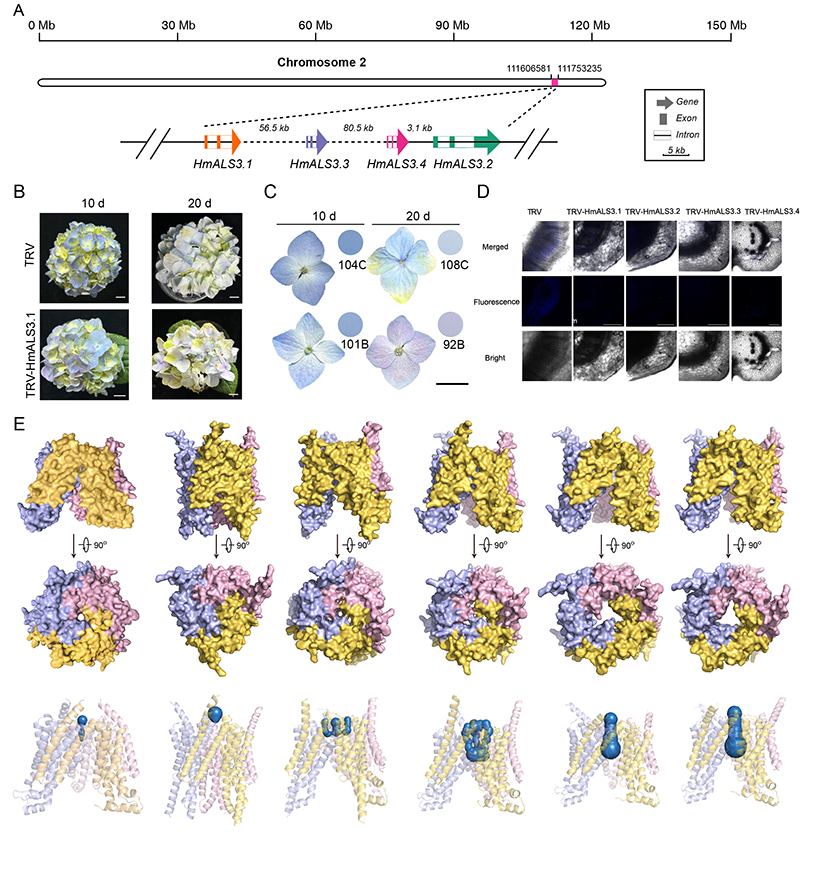
Functional assays showed that heterologous expression of HmALS3 sin yeast and Arabidopsis thalianamarkedly enhanced aluminum tolerance and accumulation capacity. In contrast, silencing this gene cluster in hydrangea impaired vacuolar aluminum sequestration and caused a visible phenotypic change in sepal color from blue to pink. Comparative genomic analysis of multiple representative aluminum-hyperaccumulating plants—including Camellia Species (Camellia oleifera, Camellia sinensis) and Malabar Melastome (Melastoma malabathricum)—revealed that all these species underwent varying degrees of ALS3 gene copy number expansion. This suggests that ALS3 family gene amplification represents a convergent evolutionary strategy shared among aluminum-hyperaccumulating plants.
This study clarifies a novel mechanism of aluminum hyperaccumulation based on gene cluster formation and heteromeric oligomerization, providing important genetic targets for breeding aluminum-tolerant crops and developing phytoremediation strategies for acidic soils.
The Institute of Vegetables and Flowers, CAAS was the sole affiliated institution of this work. Assistant Researcher Youwei Fan and graduated Master's student Shuwen Luo are co-first authors, and Associate Researcher Suxia Yuan is the corresponding author. This research was financially supported by t the National Key Research and Development Program of China (2023YFD1200105), the Central Public interest Scientific Institution Basal Research Fund, and the Agricultural Science and Technology Innovation Program of the Chinese Academy of Agricultural Sciences.
Original article link: https://doi.org/10.1016/j.jhazmat.2026.142625

 Chinese