Recently, the Cabbage and Broccoli Research Group at the Institute of Vegetables and Flowers, Chinese Academy of Agricultural Sciences, published a research paper titled "A rapid pre-screening and validation workflow for CRISPR-based genome editing in broccoli" in the internationally renowned horticultural journal Horticulture Research (IF=9.5, Q1). This study addresses the pain point of the lack of efficient pre-screening systems for vector and target selection in broccoli genome editing, and innovatively established a rapid pre-screening and validation workflow integrating protoplasts, the RUBY reporter gene-based hairy root system, and callus.
The core highlight of this study lies in its innovative pre-validation strategy. The team comprehensively utilized protoplast transient transformation, RUBY reporter gene-mediated hairy root transformation, and a callus regeneration system to achieve rapid assessment of CRISPR/Cas9 vectors and sgRNA activity. Experimental results showed that in the protoplast system, the editing efficiencies of eight sgRNAs targeting auxin signaling genes ranged from 2.63% to 12.65%. Meanwhile, the RUBY-based hairy root transformation enabled rapid visual validation of targeted editing events at a transformation efficiency of approximately 17.9%, proving to be more time-efficient and effective compared to whole-plant stable transformation. Particularly noteworthy is that the study further extended the application of Prime Editing technology in broccoli. The research team constructed prime editing vectors carrying the RUBY reporter gene and successfully detected the expected site-specific replacement events in protoplasts and callus. The average efficiency of the expected CCT-to-AGC replacement in protoplasts was . Furthermore, RUBY-positive callus could be obtained in approximately 20–25 days, and editing events were confirmed by deep sequencing. Although the overall efficiency still requires improvement (expected replacement efficiency in callus was ), it fully demonstrates the feasibility of this technical route for targeted breeding in broccoli.
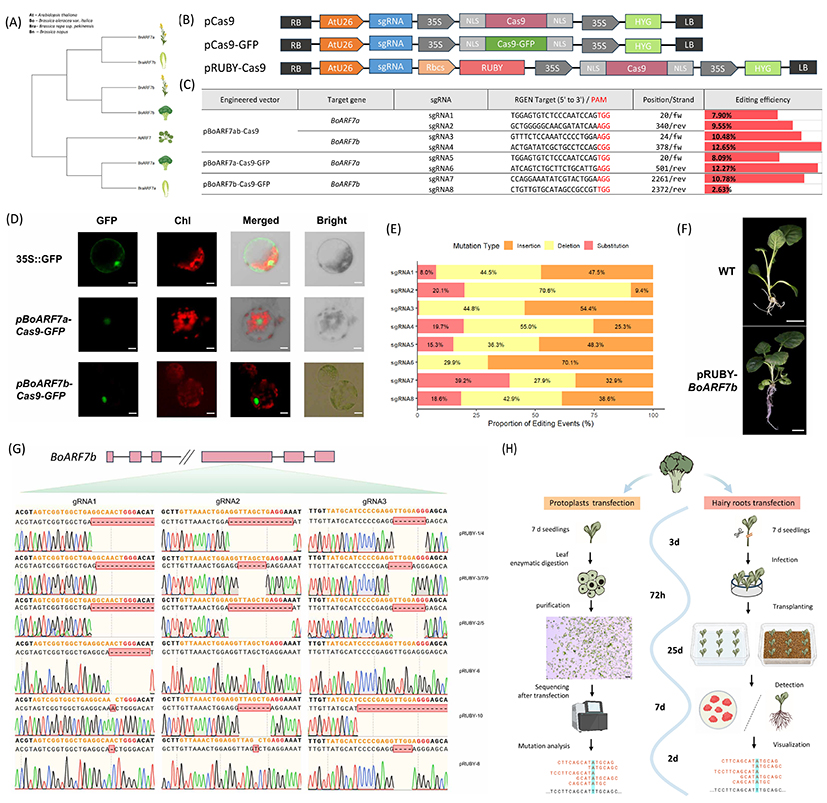
This biological breeding achievement effectively solves the problem of difficult pre-screening of targets and vectors in gene editing for broccoli and other Brassica crops. By establishing an efficient pre-validation workflow, it significantly reduces the risk of stable transformation failure and resource consumption, providing a rapid and efficient gene editing tool platform for functional gene research and molecular breeding. The study also combines the visualization systems of protoplasts and hairy roots, offering a new technical paradigm for the genetic improvement of other cruciferous crops.
The Institute of Vegetables and Flowers, Chinese Academy of Agricultural Sciences, is the primary affiliation for this paper. Researcher Zhansheng Li is the corresponding author. Shang Xiang Lai, a jointly trained master's student between the Institute of Vegetables and Flowers, Chinese Academy of Agricultural Sciences, and the College of Horticultural Science, Zhejiang A&F University, along with Professor Yunxiang Zang from the College of Horticulture, Zhejiang A&F University, are co-first authors. This research was supported by the National Natural Science Foundation of China (32172580), the National Agricultural Industry Technology System (CARS-23), and the Agricultural Science and Technology Innovation Program (ASTIP), among other projects.
Original paper: https://academic.oup.com/hr/advance-article/doi/10.1093/hr/uhag294/8729377
Email: lizhansheng@caas.cn

 Chinese