Recently, the team of Xueyong Yang from the Institute of Vegetables and Flowers of the Chinese Academy of Agricultural Sciences, in collaboration with the team led by Pengcheng Wei at Anhui Agricultural University, published a research article in JIPB (Journal of Integrative Plant Biology) entitled “Development of a highly efficient prime editing platform for cucurbits enables breeding of multi-disease resistant cucumber.” The study established a highly efficient prime editing system, Csy4-PE6d, significantly improving precise editing efficiency in crops such as cucumber, melon, and pumpkin. Furthermore, this system was applied to generate cucumber germplasm with dual resistance to bacterial angular leaf spot and downy mildew through targeted editing, providing a new technical platform for gene functional studies and precision breeding in dicotyledonous crops.

Prime editing (PE) enables all types of precise genome edits, including base substitutions, insertions, and deletions, without requiring double-strand breaks or donor templates. However, PE has long been constrained in dicotyledonous crops such as cucumber, melon, and pumpkin by several bottlenecks: low genetic transformation efficiency, low prime editing activity, and difficulty in generating heritable editing events.
1.Systematic Optimization of the Genetic Transformation and Prime Editing (PE) Expression Systems
To address the issue of low genetic transformation efficiency in cucurbit crops, the research team first optimized the selection system. The introduction of spectinomycin as a selection agent significantly inhibited the growth of explants and improved the transformation efficiency of cucumber, melon, and pumpkin (Fig. 1A, B). Building on the improved genetic transformation system, the expression of the PE protein were further optimized. Replacing the CaMV35S promoter with the tomato-derived SlEF1α promoter increased the editing efficiency of the ePE2 system at target sites in cucumber by up to 5.4-fold (Fig. 1C), indicating that promoter optimization can significantly enhance the activity of the PE system in cucumber.
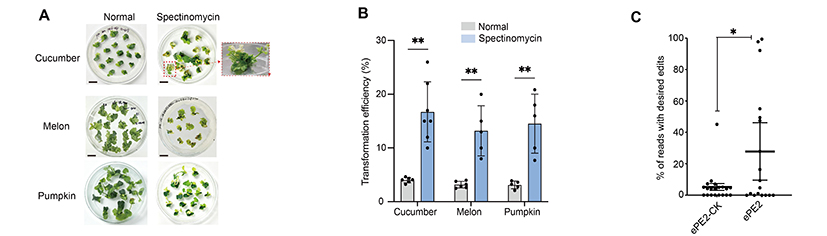
Fig1. Optimization of genetic transformation selection and promoter enhances editing efficiency in cucumber.
2. Csy4-PE6d Enables Efficient and Homozygous Precise Editing
To further enhance the stability and processing efficiency of pegRNAs, the team integrated the Csy4 ribonuclease and constructed five PE systems (Fig. 2A). Three target sites within the cucumber genes CsYUC4, CsARF3, and CsCCD1 were selected to introduce base substitutions and insertion. Finally, the Csy4-PE6d system with the best performance was selected.
In the obtained T0 lines, the average frequency of lines carrying the desired edit of Csy4-PE6d was 80.83%, and Csy4-PE6d generated homozygous edits in 36.44% of lines (Fig. 2B, C, D). High homozygous editing efficiency facilitates the rapid fixation of target alleles in early generations, thereby providing an important technical foundation for shortening the precision breeding cycle.
3. Broad Applicability across Diverse Dicot Crops
To further evaluate the editing performance of Csy4-PE6d in other dicot crops, we performed targeted precise editing on the homologous gene Cals1 in melon, pumpkin and potato. The desired PE frequencies were 70.00% in melon lines, 78.26% in pumpkin lines, and 18.75% in potato lines, respectively (Fig 2E). These results indicate that Csy4-PE6d is not only applicable to cucumber but also exhibits robust editing activity in a range of dicot crops, including soybean, thereby providing a foundation for its further application in diverse horticultural and economic crops.
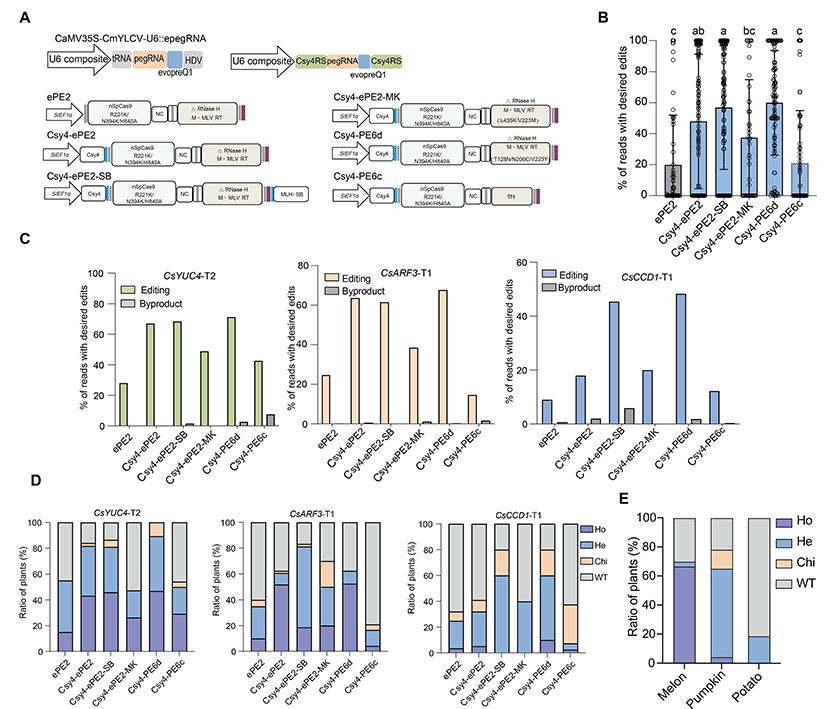
Fig2. Construction of the Csy4-PE6d system and its efficient editing in various dicotyledonous crops
4. Precise Generation of Cucumber Germplasm with Dual Disease Resistance
Bacterial angular leaf spot (ALS) and downy mildew (DM) are the important diseases that are widely prevalent among cucumbers and cucurbit crops. The team employed Csy4-PE6d to introduce a precise A to G base substitution at position A323 in CsSGR of susceptible cultivar 9930, and obtained T1 generation, T-DNA-free edited plants (sgr) (Fig 3A).
Pathogen inoculation assays revealed that the susceptible cultivar 9930 exhibited severe disease symptoms, whereas the sgr lines showed significantly enhanced resistance to both bacterial angular leaf spot and downy mildew, with a resistance phenotype comparable to that of the naturally resistant accession Gy14 (Fig. 3B). These results indicate that Csy4-PE6d not only enables highly efficient and precise editing, but can also be directly applied to the targeted generation of excellent agronomic traits, demonstrating its potential for application in precision crop breeding.
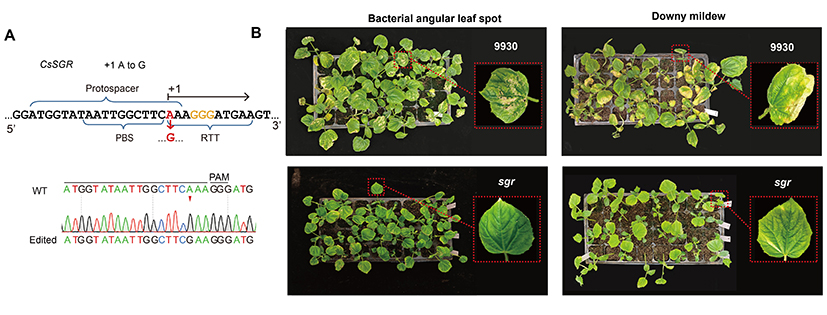
Fig3. Csy4-PE6d-mediated targeted generation of cucumber germplasm with dual disease resistance
Through optimization of the genetic transformation system, enhancement of PE protein expression, and Csy4-mediated optimization of pegRNA processing, this study established a highly efficient Csy4-PE6d prime editing platform. This system achieved high efficiency, high frequency homozygous precise editing in cucumber and can be applicable to multiple dicot crops, including melon, pumpkin, and potato. Furthermore, the system was employed to precisely generate cucumber germplasm with dual resistance to bacterial angular leaf spot and downy mildew, which verified its practical value in precision breeding. This study provides a new and efficient tool for gene functional analysis, generation of elite alleles, and precision breeding in cucurbit and other dicot crops.
Junya Wang(postdoctoral researcher) and Ling Xiao (PhD candidate) from the Institute of Vegetables and Flowers, Chinese Academy of Agricultural Sciences, and Professor Tongxu Xin from Anhui Agricultural University are the co-first authors. Professor Xueyong Yang from the Institute of Vegetables and Flowers, Chinese Academy of Agricultural Sciences, and Professor Juan Li from Anhui Academy of Agricultural Sciences are the co-corresponding authors. Jian Ling from the Institute of Vegetables and Flowers, Chinese Academy of Agricultural Sciences, provided valuable assistance with pathogen inoculation, and Professor Pengcheng Wei from Anhui Agricultural University, provided important guidance for this study. This work was supported by the National Natural Science Foundation of China, the Science and Technology Innovation Program of the Chinese Academy of Agricultural Sciences, State Key Laboratory of Vegetable Biobreeding, and the Beijing Rural Revitalization Agricultural Science and Technology Project, among others.
https://www.jipb.net/EN/10.1111/jipb.70375

 Chinese