How does natural selection drive biological evolution while simultaneously imposing hidden costs? This question represents a central theme in evolutionary biology. A striking example is the evolution of insecticide resistance in agricultural pests: the enhanced ability to survive chemical control is often accompanied by reduced reproductive capacity, creating an evolutionary trade-off. However, the molecular “switch” underlying this balance has remained largely unknown.
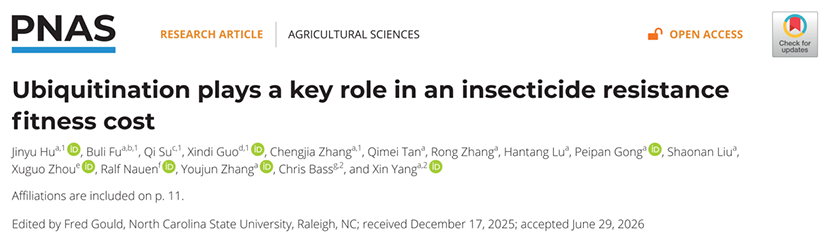
Recently, the research team led by Academician Youjun Zhang at the Institute of Vegetables and Flowers, Chinese Academy of Agricultural Sciences, published a research article entitled “Ubiquitination plays a key role in an insecticide resistance fitness cost” in the internationally renowned journal Proceedings of the National Academy of Sciences (PNAS). This study systematically revealed the molecular mechanism by which ubiquitination-mediated regulation drives evolutionary trade-offs associated with insecticide resistance. The work provides the first direct evidence linking ubiquitination, a fundamental cellular regulatory process, with the evolution of insecticide resistance and its associated reproductive fitness cost. These findings advance our understanding of the insect ubiquitination system and its role in adaptive evolution, while providing new insights for sustainable pest management strategies.
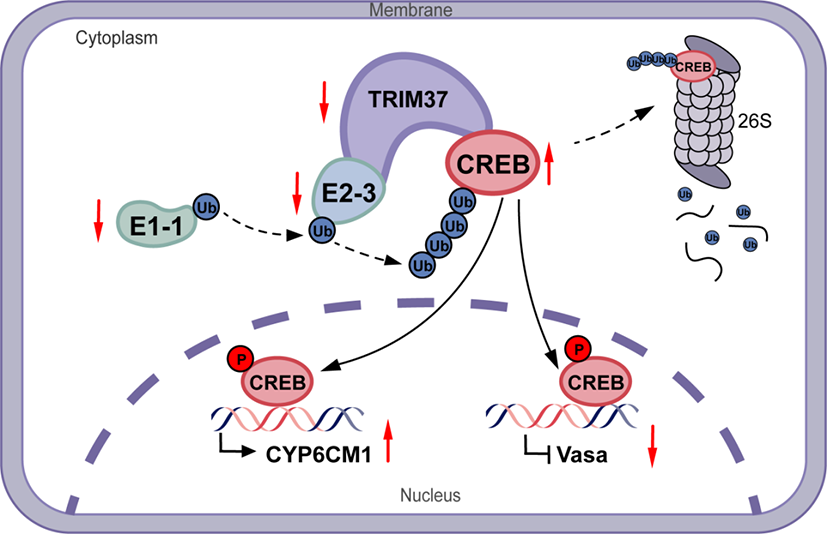
The whitefly Bemisia tabaci, widely recognized as a global “super pest”, is one of the most destructive agricultural pests and a major threat to protected vegetable production in China. Long-term resistance monitoring has shown that field populations of B. tabaci have developed high levels of resistance to neonicotinoid insecticides, which are among the most widely used control agents. However, the evolution of resistance is frequently accompanied by substantial fitness costs, particularly reduced reproductive performance. To investigate the molecular basis underlying this evolutionary trade-off, the researchers discovered that the RING-type E3 ubiquitin ligase TRIM37 regulates the stability of the transcription factor CREB through an E1-1/E2-3/TRIM37 ubiquitination cascade. This regulatory pathway simultaneously promotes the overexpression of the detoxification gene CYP6CM1, which confers neonicotinoid resistance, and suppresses the key oogenesis gene Vasa, resulting in reduced reproductive capacity. In resistant whitefly populations, downregulation of TRIM37 leads to the accumulation of CREB protein. This single molecular event shifts the balance between survival and reproduction, thereby mediating both insecticide resistance and its associated reproductive fitness cost.
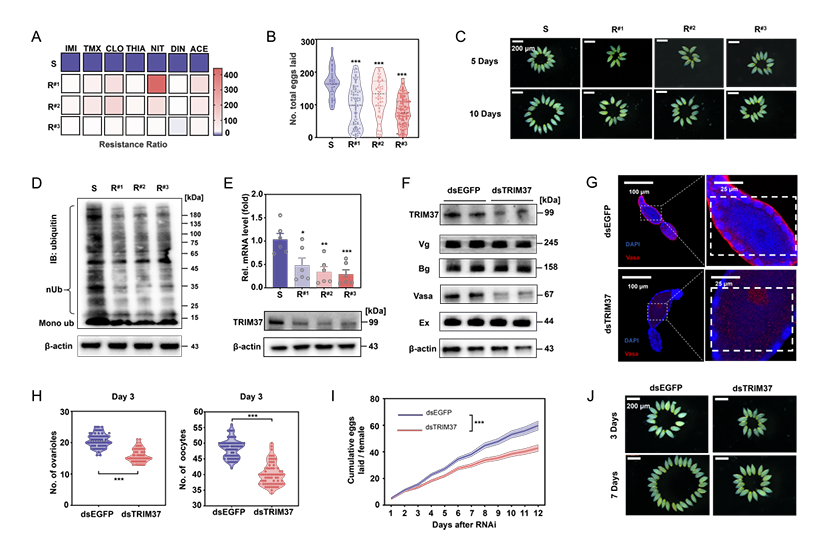
“This study provides the first evidence that ubiquitination, a fundamental cellular process, directly contributes to the fitness costs associated with insecticide resistance evolution,” the researchers stated. “It addresses a fundamental question: why is insecticide resistance evolution not a ‘free lunch’? The answer lies in the ubiquitination-mediated regulatory balance, where enhanced resistance is achieved at the expense of reproductive fitness.”
The editor of PNAS, Academician Fred Gould from the United States National Academy of Sciences, commented that this study is “highly innovative and significantly advances our understanding of the genetic mechanisms underlying resistance evolution.” This work represents a milestone in the team’s systematic investigation of neonicotinoid resistance mechanisms in B. tabaci.
Previous studies by the team demonstrated that the predominant resistance mechanism of field B. tabaci populations in China involves metabolic detoxification mediated by overexpression of cytochrome P450 genes, and further investigated the regulatory mechanisms controlling key resistance genes (PNAS, 2020). Subsequently, the team revealed that the GPCR–MAPK signaling pathway regulates phosphorylation of the transcription factors CREB/CncC, thereby controlling the transcriptional expression of resistance-related P450 genes and three reproductive genes, Ex, Vasa, and Bg (PNAS, 2024).
The present study further expands this regulatory network by revealing the role of ubiquitination-mediated protein degradation. Specifically, the E1–E2–E3 ubiquitination cascade regulates CREB protein stability, thereby coordinating insecticide resistance development and reproductive fitness costs. Through a series of three PNAS research articles, the team has progressively uncovered the molecular mechanisms by which field populations of B. tabaci acquire high-level resistance to neonicotinoid insecticides and the biological costs associated with this adaptation, providing important theoretical foundations for resistance management and the development of novel pest control strategies.
The Institute of Vegetables and Flowers, Chinese Academy of Agricultural Sciences, served as the first affiliation of this study. Dr. Jinyu Hu, a second-year Ph.D. student at the institute, was the first author of the paper. Associate Professor Buli Fu from the Chinese Academy of Tropical Agricultural Sciences, Professor Qi Su from Yangtze University, Dr. Xindi Guo from the Institute of Food and Nutrition Development, Ministry of Agriculture and Rural Affairs, and Dr. Chengjia Zhang from Hunan Academy of Agricultural Sciences were co-first authors. Academician Youjun Zhang provided important guidance for the study. Professor Chris Bass from the University of Exeter and Professor Xin Yang at the institute served as co-corresponding authors.
This research was supported by the Science Fund for Creative Research Groups of the National Natural Science Foundation of China, the International (Regional) Cooperation and Exchange Project, General Program of the National Natural Science Foundation of China, and the Science and Technology Innovation Program of the Chinese Academy of Agricultural Sciences.
Original article: https://www.pnas.org/doi/10.1073/pnas.2536664123

 Chinese